
Reviews20 July 2026
The five-star review engine: how review momentum actually works for trade businesses
Every happy customer says they'll leave a review. Why they never do, and the system that catches the promise the same day.
A sparky in Western Sydney finishes a switchboard upgrade late on a Thursday. The homeowner walks him out to the ute, genuinely rapt. Mate, you've been brilliant, I'll chuck you a Google review tonight. Both of them mean it.
By the time the kids are fed and the dishwasher is stacked, the promise is gone. Not because the homeowner changed his mind. Because search for the business on Google, find the right listing, work out where the review button lives is five steps too many on a Thursday night.
Multiply that across two hundred jobs a year and you can see the quiet cost. A wall of a hundred and fifty reviews that never got built, from customers who all said yes.
What a thin review profile actually costs
Sit on the tailgate at smoko and search your own trade and suburb the way a customer would. A plumber in Penrith does exactly this and watches a competitor with 180 reviews at 4.9 stars fill the top of the map results, while his own profile sits on 11 reviews, the newest from 2022. Same ticket, same standard of work. The three-quote homeowner never scrolls far enough to find him. And the quotes he does win, he wins on price, because he cannot win on proof.
It reaches word of mouth too. Research commissioned by hipages found more than 70 per cent of consumers still engage tradies through word of mouth or a tradie they have used before (Climate Control News). That sounds like a reason to ignore Google. It is the opposite, because the referral no longer goes straight to a phone call. A neighbour says use our roofer, he's a legend, over the fence on a Saturday. That night the homeowner googles the name and finds a profile with four reviews, the newest from 2019, no photos, no replies. The business with 130 reviews two suburbs over gets the booking, and the roofer never finds out the referral even happened.
Homeowners do not really use reviews to discover tradies. They use them to eliminate tradies, and to break ties between the last two quotes. A thin or stale profile does not shout at anyone. It just quietly fails that audit, job after job, and the owner never sees it happen.
Why don't happy customers just leave reviews?
Because almost nobody reviews unprompted, good or bad. The exception is the unhappy minority, who publish without any encouragement at all. Plenty of owners discover this on a Sunday night doing invoices. The only two reviews this year are from the customer who complained about parking and the one who disputed a call-out fee, while sixty genuinely happy customers were never asked.
The asking is where it breaks down. The face-to-face ask at handover feels like begging, so it keeps not happening. Even owners who fully intend to send a text later are relying on their own memory at 4:30 on a Friday with three jobs still open. Yet when the ask actually lands, people come through at a rate most tradies would not believe. The BrightLocal Local Consumer Review Survey found that 83 per cent of people who were asked to leave a review went on to leave one. The gap between the customer said they'd sort us a review and the review actually existing comes down to one thing: whether a direct link landed on their phone the same day.
How does the review engine actually work?
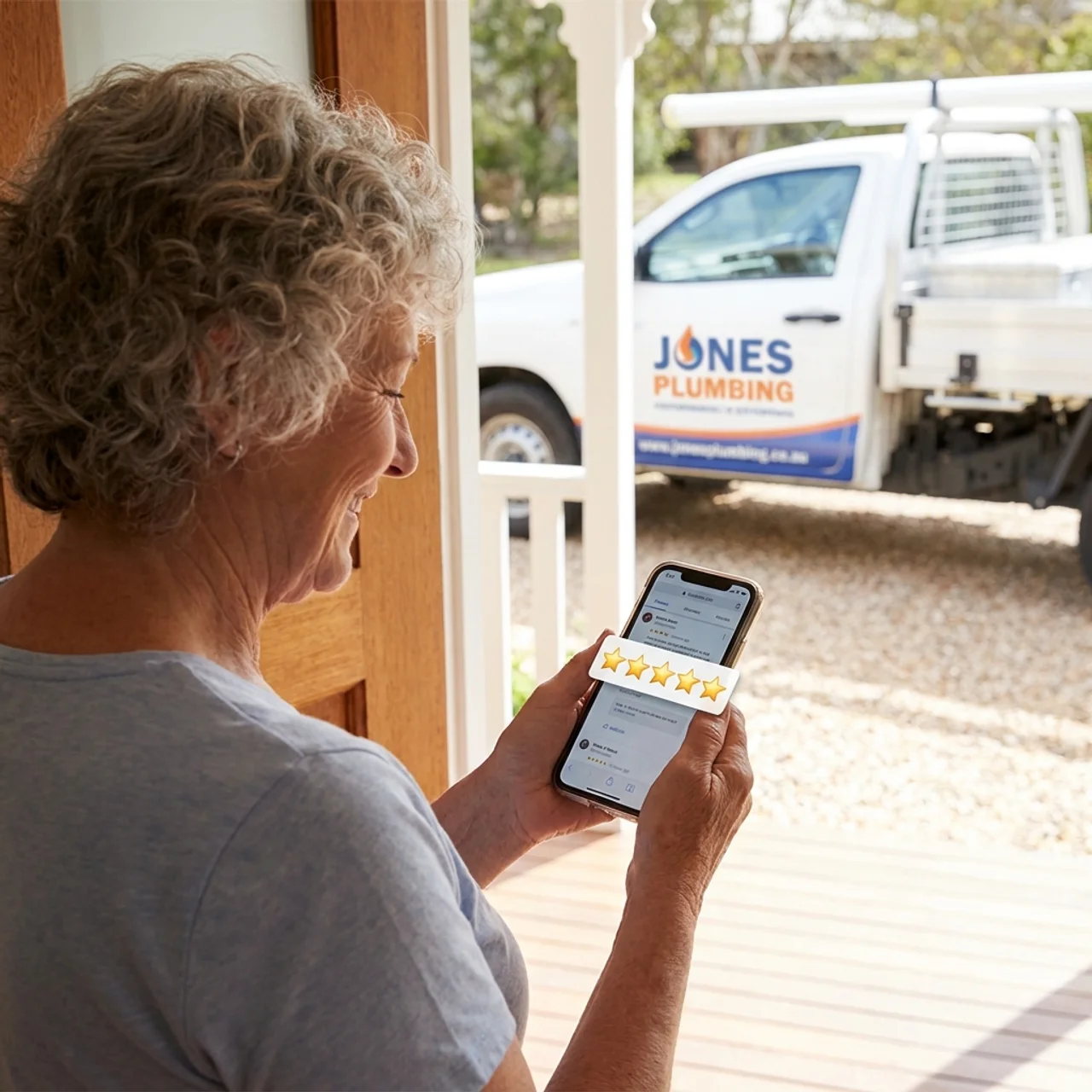
It hangs off the job workflow you already run. When a job is marked complete in ServiceM8, Tradify or the backend we set up, a short SMS goes out an hour or two later, while the goodwill is still warm. It uses the customer's first name, it reads like the tradie who was just in their kitchen rather than a robot, and it carries the one thing that matters: a direct link that opens the Google review box. Not search for us on Google. One tap.
If nothing happens, the system circles back once a few days later, politely, then leaves the customer alone. Every review that lands gets a reply, because replies are the only part of your review wall you fully control, and they are the part future customers read to judge how you handle a dispute. Then the next job completes, the next ask goes out, and the wall keeps growing without the owner remembering anything.
The rhythm matters as much as the volume. A steady trickle of three to five reviews a month, specific, dated, mentioning the suburb and the job, reads as a living business to both Google and homeowners. Twenty five-star reviews in a single week, all from accounts with one review each, reads as bought, and homeowners have a sharp radar for that. The engine is built to produce the trickle, never the blitz.
It is the same insight behind the missed-call textback, applied twice. The moments that decide whether you get the job tend to happen while you are elbow-deep in a subfloor with the phone ringing out in the ute. So the system has to fire without you.
What changes for the business
Nothing changes on the tools. Nobody memorises a script or pushes through the awkward moment at handover. The asking stops depending on memory and courage, and starts depending on job completion, which is the one thing a busy trade business produces reliably.
Within a few months the profile starts to look like the business actually is. Recent, specific, replied to. Quotes convert differently when the homeowner has already read a dozen reviews from their own suburb before you knock. Referrals stop leaking, because the Saturday recommendation now survives the Saturday night search. And it compounds, because better proof wins more jobs and every finished job feeds the wall. The review engine is one of the systems we install for exactly this reason, and it pairs naturally with answering quotes fast. Proof gets you shortlisted. Speed gets you chosen.
What it doesn't fix
It will not screen out the whingers, because we do not gate reviews. Sending a satisfaction survey first and only pointing the happy customers at Google breaches Google's review policies, and ACCC guidance makes incentivised or filtered reviews legally risky in Australia, so if you ask everyone, the occasional unhappy customer gets asked too. Our view is that they were going to publish anyway, and the engine simply stops them being the only voice on your wall. Not everyone comes through either. Some customers promise and forget forever, some clientele, older homeowners, builders, real estate property managers, will never review anything, and Google quietly filters some legitimate reviews from newer accounts, which owners experience as reviews vanishing. Most of all, the engine amplifies what is already true. Automated asks pointed at sloppy work just document the sloppiness faster. It multiplies proof of good work. It cannot manufacture the work.
If your newest review is a few years old, the work is probably fine and the asking is what is broken. We can look at your profile with you and show you what your current job volume would build in six months. The booking link is just below.
All resources